Why hand saddle-stitching outlasts a machine
Two needles, one seam, and the reason a hand-sewn wallet won't unravel when a single thread gives out.
Every seam we sew takes an hour or more that a sewing machine could do in seconds. Fair question: why bother? The answer is in how the two stitches behave when something goes wrong.
How a machine stitch works
A lockstitch machine uses two threads, a top thread and a bobbin thread, that interlock between the layers of leather. It's fast and consistent, and each loop depends on its neighbors. If the thread wears through at one point, the interlock there releases, and the seam can start loosening along its length, the way a stocking runs from one snag.
On a wallet that flexes in a back pocket thousands of times a year, the corners are where that wear happens first.
How a saddle stitch works
A saddle stitch uses one thread with a needle on each end. The two needles pass through the same hole from opposite sides, so the thread crosses itself inside every hole. Each stitch is locked independently.
If a stitch wears through, the crossings on either side hold the thread ends in place, and the damage mostly stays where it started. The seam keeps working until it's repaired.
The stitch comes from saddlery, where a failed seam could put a rider on the ground. That's the job it was developed for: a seam that fails slowly and visibly instead of all at once.
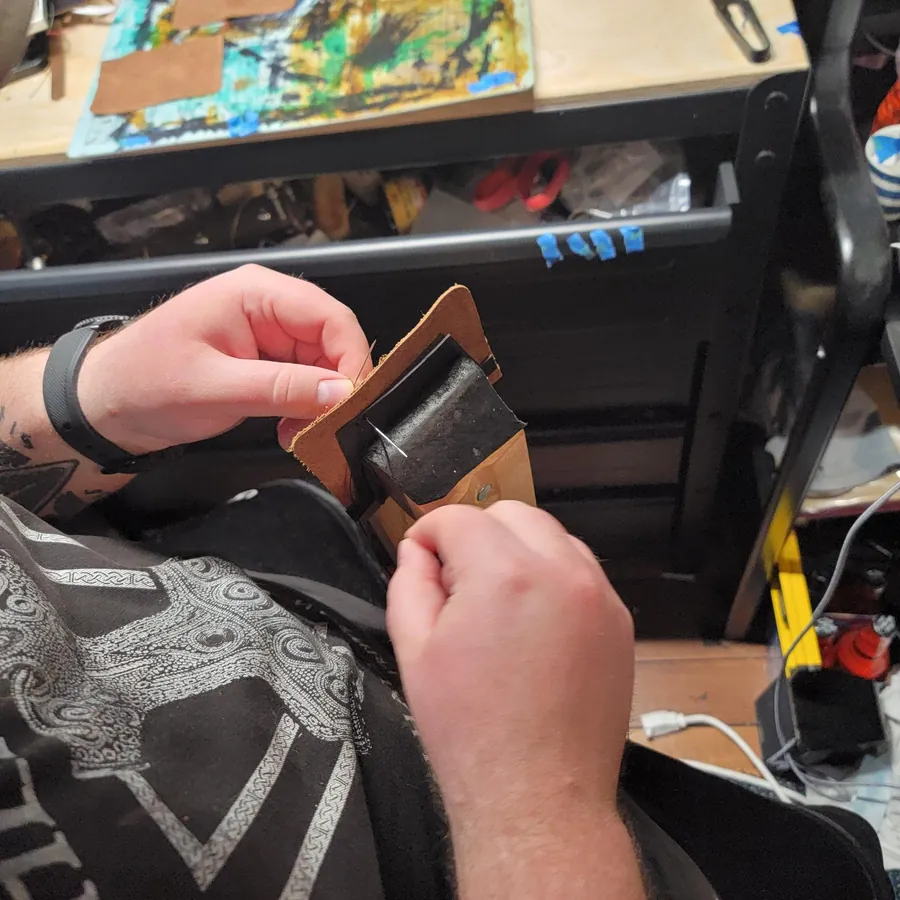
The differences you can feel
- Tension. Each stitch is pulled snug by hand, so the thread sits slightly recessed into the leather, protected from abrasion. Machines run lower tension to keep their speed. That's the right call for production, but the thread sits prouder and wears sooner.
- Thread. We sew with braided polyester (Tiger thread, the modern saddler's standard). It's thicker than what production machines typically run, because heavy thread and dense leather are slow to sew by machine.
- The holes. We make ours with stitching irons sized to the thread, so the leather closes back snugly around every stitch.
The honest trade-off
Hand-stitching is slow, and it's the biggest reason handmade goods cost more than factory-made ones. A machine-sewn wallet is cheaper and serves plenty of people well.
We sew by hand because we want the seam to outlast the leather around it, and because when a hand-sewn seam does eventually need attention, it's a simple repair instead of a re-make. And if a stitch on anything we made fails within the first year, email us and we'll repair it free.
Made by hand
Everything we write about, we practice at the bench. See the goods it produces — wallets, belts, and bags saddle-stitched to be kept for life.
Visit the shop